It’s time to move from Theory to Reality
XM Cyber vs Horizon3
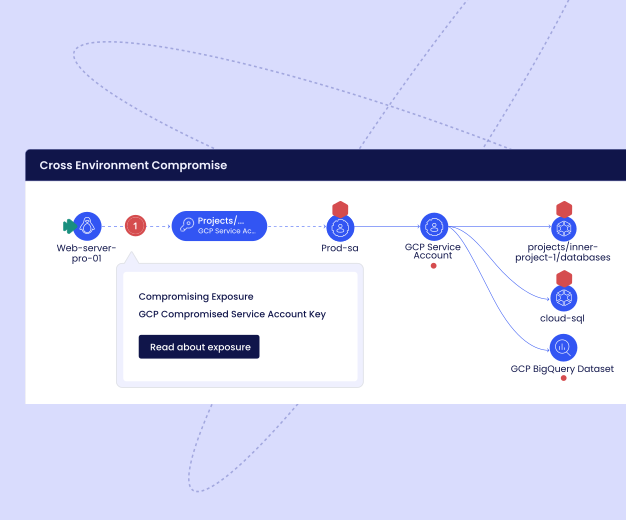
XM Cyber provides complete visibility across the entire attack surface, uncovering how assets, identities and exposures interconnect to form attack paths. Using a digital twin approach, the platform provides continuous validation without the risk to production or service availability inherent in traditional penetration testing tools.
Why XM Cyber?

The XM Cyber Difference:
An Integrated Exposure Management Platform
Features
-
Scenario-based Penetration Testing and Attack Simulation
Automatically test your attack surface against real-world attack scenarios, using TTPs aligned with MITRE ATT&CK.
-
Complete Attack Surface Visibility Across Hybrid Environments
While testing tools offer localized exposure insights inside specific execution windows , true risk management requires continuous visibility. XM Cyber delivers deep, 24/7 contextual awareness, mapping every asset, cloud resource, and identity across your entire hybrid surface, ensuring you are never blind between scheduled tests.
-
In-House Threat Research and Adversary Intelligence
XM Cyber goes beyond basic validation by unifying vulnerability data, cloud security posture, and active controls assessment into one continuous engine. Instead of a black-box approach that only flags what a specific exploit library can weaponize today , XM models full exposure classes, including complex Active Directory and identity misconfigurations, whether a public exploit code exists or not.
-
Production-Safe Continuous Exposure Validation
XM Cyber’s safe-by-design Digital Twin architecture executes continuous validation entirely in a simulated environment. This provides zero risk of disruption or downtime to live production workloads and completely eliminates the operational drag of scheduling change windows, managing exclusion lists, or seeking organizational test approvals
-
Interoperability with Existing Security Tooling
XM Cyber offers seamless integration with existing solutions via flexible APIs ensuring seamless context enrichment without firing excessive alerts across existing tools.
-
Enable efficient and effective Remediation Operations
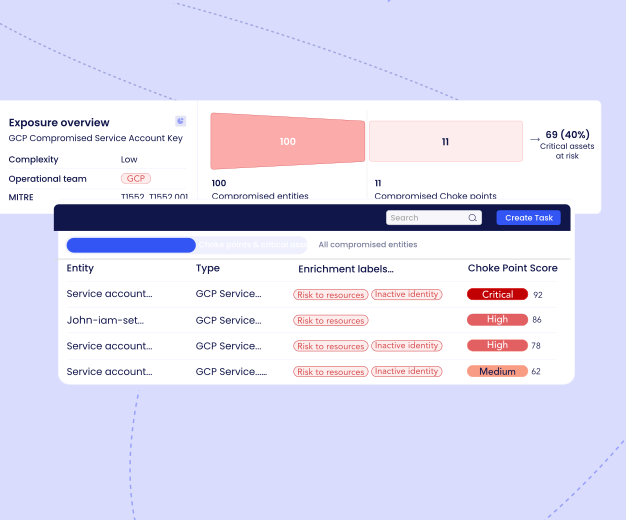
XM Cyber doesn't just hand teams a massive, linear list of individual exploitable vulnerabilities or attack paths to chase down. By focusing on Choke Points, the platform isolates the critical intersection points that collapse thousands of potential attack paths at once. This allows security teams to eliminate maximum risk with the fewest possible fixes.


-
Scenario-based Penetration Testing and Attack Simulation
Automatically test your attack surface against real-world attack scenarios, using TTPs aligned with MITRE ATT&CK.
-
Complete Attack Surface Visibility Across Hybrid Environments
While testing tools offer localized exposure insights inside specific execution windows , true risk management requires continuous visibility. XM Cyber delivers deep, 24/7 contextual awareness, mapping every asset, cloud resource, and identity across your entire hybrid surface, ensuring you are never blind between scheduled tests.
-
In-House Threat Research and Adversary Intelligence
XM Cyber goes beyond basic validation by unifying vulnerability data, cloud security posture, and active controls assessment into one continuous engine. Instead of a black-box approach that only flags what a specific exploit library can weaponize today , XM models full exposure classes, including complex Active Directory and identity misconfigurations, whether a public exploit code exists or not.
-
Production-Safe Continuous Exposure Validation
XM Cyber’s safe-by-design Digital Twin architecture executes continuous validation entirely in a simulated environment. This provides zero risk of disruption or downtime to live production workloads and completely eliminates the operational drag of scheduling change windows, managing exclusion lists, or seeking organizational test approvals
-
Interoperability with Existing Security Tooling
XM Cyber offers seamless integration with existing solutions via flexible APIs ensuring seamless context enrichment without firing excessive alerts across existing tools.
-
Enable efficient and effective Remediation Operations
XM Cyber doesn't just hand teams a massive, linear list of individual exploitable vulnerabilities or attack paths to chase down. By focusing on Choke Points, the platform isolates the critical intersection points that collapse thousands of potential attack paths at once. This allows security teams to eliminate maximum risk with the fewest possible fixes.
Connect to hundreds of distribution channels


What Our Customers Say

״XM Cyber helped us to go from thousands of critical vulnerabilities that we have to just 10, 15 that we could fix. And with this, we prevented the breach of our crown jewels.”


“As a security leader, I will recommend XM Cyber Services because it allows to drive your remediation, and helps you to focus on what it matters the most. XM Cyber offers us the possibility to be in a hacker mindset and to be able to determine the attack path to a critical asset which no other security tool offers.”

“We found XM Cyber’s platform to be a very mature product with holistic view, something that shows the entire network and shows us how to get from A to B to Z”

“Monitoring, dynamically, continuously, how the posture is changing and the capability to correct possible configuration mistake”


“One of the things that I liked the most was that it presented resolutions for the exposures you have, and not just one, it presents us with several resolutions, several possibilities to remediate the exposures, and I liked that”


“XM Cyber is an important layer of security… Normally, you have to prove to IT to patch and change configurations. Not with XM Cyber.”


“Understanding different attack types and how they move around in an environment, that’s really where XM Cyber plays a big part for us.“


“To date we improved our score from 69 to 87. This was highly appreciated by my directors on the last board meeting.”

Total Economic Impact Study™ of XM Cyber
394%
Return on investment, with payback in under 6 months
$12.4M
Reduction in remediation, fines, lost revenue, and brand reputation costs
$1.4M
Reduction in costs associated with penetration testing
90%
Reduction in the likelihood of experiencing severe breach
FAQs
Can automated penetration testing tools replace regular vulnerability scanners?
No, Automated pentesting tools help by validating whether specific, individual vulnerabilities can actually be weaponized, but are not a suitable replacement. These tools are used in tandem with vulnerability scanners, often ingesting findings directly, as a means of prioritization, where scanners often focus on exposure discovery.
Does continuous validation require active testing in production environments?
No, it is not required to run active tests in live production environments. While automated penetration testing vendors like Horizon3 run active tests in your production environments, XM Cyber uses a digital twin approach – dynamically replicating your entire environment and validating exposures through scenario-based testing without risk to live production workloads.
How often are tests run? How does the system take into account state changes or ephemeral resources?
With typical automated penetration testing platforms, tests are run periodically, either launched manually on-demand or automated on a recurring schedule (e.g., weekly, bi-weekly, or monthly) using a background orchestration agent like the NodeZero Runner. Because it launches active, live exploits directly against production systems, testing is often restricted to predefined operational execution windows.
XM Cyber operates as a continuous exposure management platform. It does not rely on scheduled execution windows or manual triggers. Instead, validation runs continuously in an active loop, constantly calculating and generating hybrid attack graphs as new assets and/or exposures are discovered.
Managing network drift and short-lived assets highlights the fundamental difference between point-in-time testing and continuous simulation. Because Horizon3 operates on a scheduled, agentless model, it can only see what is active and reachable during its active test window; if an ephemeral cloud resource or a temporary configuration vulnerability spins up and terminates between tests, it remains a complete blind spot. Conversely, XM Cyber constantly ingests real-time context such as infrastructure changes, cloud state adjustments, and active identity permissions, simulating attack paths automatically the moment the environment drifts so you never lose visibility between scheduled cycles.
What are the limitations of AI-driven exploit tools when mapping lateral movement?
The primary limitation of automated attack tools is that they can only validate what they can actively weaponize using their current library of exploit modules. If an attacker can move laterally across your network using a complex chain of identity misconfigurations or overly permissive account privileges that don’t rely on a specific public exploit code, a tool focused strictly on exploitation will miss it entirely.
The most effective platforms analyze full exposure classes. By mapping the hidden trust relationships, cached credentials, and Active Directory structures across your entire environment, the system can calculate every theoretically possible lateral movement step an attacker could take, whether a public exploit payload exists for it today or not.
How do you choose between Breach & Attack Simulation (BAS) and automated pentesting for a CTEM program?
Automated pentesting tools focus primarily on a single milestone: providing localized proof of what can be compromised during a specific execution window. Meanwhile, legacy BAS tools focus heavily on testing individual security controls using isolated technique simulations. Neither natively orchestrates the full, broader scope of a CTEM program on its own.
The standard for modern exposure validation has evolved. XM Cyber’s approach entails incorporating exposure validation at every single stage of the CTEM lifecycle, serving as a critical, core capability of a modern Exposure Assessment Platform (EAP). Rather than treating validation as an episodic, standalone event, an enterprise-grade EAP continuously unifies vulnerability data, cloud security posture, identity context, and active control validation into a single, cohesive engine. This ensures that your validation efforts actively drive remediation efficiency, showing you exactly how security gaps interconnect across your environment to threaten your most critical business assets.
Whichever tooling approach is utilized, it is absolutely critical that security teams validate exposures and hybrid attack paths dynamically and holistically, while fully taking into account the real-world presence and live configurations of existing security controls.
Attackers don’t work in silos.
Neither should you