XM Cyber vs Microsoft
XM Cyber provides continuous exposure management across hybrid and multi-cloud environments, utilizing a safe-by-design digital twin approach to uncover and validate how assets, identity permissions, and exposures interconnect to form complex attack paths leading to critical enterprise data. By taking a platform-agnostic, adversary-aware approach, the platform continuously tests your entire attack surface against real-world attack scenarios to identify systemic risk across your entire IT estate, ensuring you never face the blind spots or modular licensing complexity of single-vendor consolidation.
Why XM Cyber?

An Integrated Exposure Management Platform
Features
-
Complete Attack Surface Visibility
While Microsoft has a strong ecosystem bias toward its own asset types and software, customers can only achieve broad attack surface visibility if they piece together a massive, costly portfolio of individual Defender point solutions and add-on modules. Alternatively, XM Cyber provides a unified, platform-agnostic Continuous Exposure Management solution across hybrid and multi-cloud environments natively from day one.
-
Continuously Discover a Broad Set of Exposure Types
Both XM and Microsoft offer a diverse set of assessment approaches, including a mix of agent-based and agentless scanning to discover CVEs, misconfigurations and identity-related risk.
-
Cross-Environment Attack Path Mapping
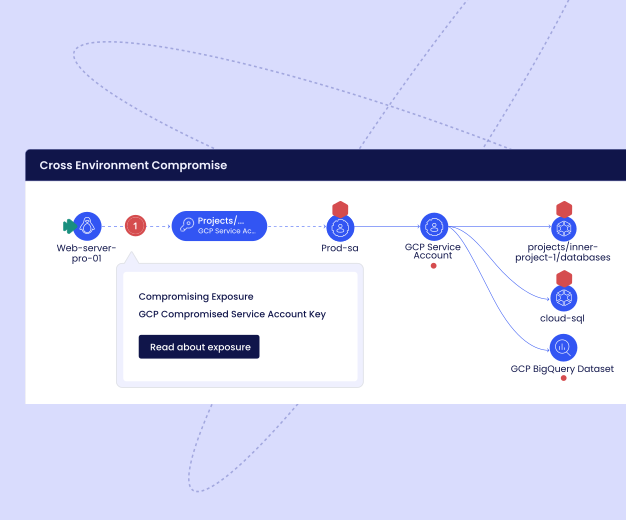
Microsoft provides attack path mapping inside specific connected environments, but tracking cross-domain context outside their native ecosystem introduces visibility friction. Conversely, XM Cyber’s engine holistically maps your entire IT estate, uncovering hidden, bidirectional lateral movement routes where an attacker uses on-premises infrastructure or complex identity misconfigurations to pivot seamlessly into cloud-native resources, and vice versa.
-
Continuous Digital Twin Validation
XM Cyber builds a real-time Digital Twin of your entire hybrid IT estate, continuously testing system exploitability against hundreds of real-world scenarios without operational risk. Microsoft offers basic attack path visibility across parts of its portfolio but lacks the comprehensive, environment-agnostic simulation engine required to move beyond basic posture metrics into verified breach validation.
-
A Sole Focus on Continuous Exposure Management
Microsoft’s core business model will always prioritize IaaS, SaaS, and hardware consumption, creating clear ecosystem biases where security features are designed to lock you into their infrastructure. XM Cyber maintains an independent, unbiased focus on pure Continuous Threat Exposure Management (CTEM), built strictly to protect your entire hybrid estate regardless of infrastructure vendor.
-
One Solution, Purpose-Built for Exposure Management
Microsoft’s Exposure Management offering is a layered interface layer requiring premium licenses for a multitude of separate Defender point products to act as data sources. Conversely, XM Cyber was built from the ground up as a standalone, purpose-built Exposure Assessment Platform (EAP), collecting full hybrid context natively via a single, featherweight sensor.


-
Complete Attack Surface Visibility
While Microsoft has a strong ecosystem bias toward its own asset types and software, customers can only achieve broad attack surface visibility if they piece together a massive, costly portfolio of individual Defender point solutions and add-on modules. Alternatively, XM Cyber provides a unified, platform-agnostic Continuous Exposure Management solution across hybrid and multi-cloud environments natively from day one.
-
Continuously Discover a Broad Set of Exposure Types
Both XM and Microsoft offer a diverse set of assessment approaches, including a mix of agent-based and agentless scanning to discover CVEs, misconfigurations and identity-related risk.
-
Cross-Environment Attack Path Mapping
Microsoft provides attack path mapping inside specific connected environments, but tracking cross-domain context outside their native ecosystem introduces visibility friction. Conversely, XM Cyber’s engine holistically maps your entire IT estate, uncovering hidden, bidirectional lateral movement routes where an attacker uses on-premises infrastructure or complex identity misconfigurations to pivot seamlessly into cloud-native resources, and vice versa.
-
Continuous Digital Twin Validation
XM Cyber builds a real-time Digital Twin of your entire hybrid IT estate, continuously testing system exploitability against hundreds of real-world scenarios without operational risk. Microsoft offers basic attack path visibility across parts of its portfolio but lacks the comprehensive, environment-agnostic simulation engine required to move beyond basic posture metrics into verified breach validation.
-
A Sole Focus on Continuous Exposure Management
Microsoft’s core business model will always prioritize IaaS, SaaS, and hardware consumption, creating clear ecosystem biases where security features are designed to lock you into their infrastructure. XM Cyber maintains an independent, unbiased focus on pure Continuous Threat Exposure Management (CTEM), built strictly to protect your entire hybrid estate regardless of infrastructure vendor.
-
One Solution, Purpose-Built for Exposure Management
Microsoft’s Exposure Management offering is a layered interface layer requiring premium licenses for a multitude of separate Defender point products to act as data sources. Conversely, XM Cyber was built from the ground up as a standalone, purpose-built Exposure Assessment Platform (EAP), collecting full hybrid context natively via a single, featherweight sensor.
Connect to hundreds of distribution channels


What Our Customers Say

“We found XM Cyber’s platform to be a very mature product with holistic view, something that shows the entire network and shows us how to get from A to B to Z”


“The assistance that XM Cyber can give to the dialogue between the CISO and the executive level and the board level is tremendous”

“Monitoring, dynamically, continuously, how the posture is changing and the capability to correct possible configuration mistake”

״XM Cyber helped us to go from thousands of critical vulnerabilities that we have to just 10, 15 that we could fix. And with this, we prevented the breach of our crown jewels.”


“One of the things that I liked the most was that it presented resolutions for the exposures you have, and not just one, it presents us with several resolutions, several possibilities to remediate the exposures, and I liked that”


“XM Cyber is an important layer of security… Normally, you have to prove to IT to patch and change configurations. Not with XM Cyber.”


“Understanding different attack types and how they move around in an environment, that’s really where XM Cyber plays a big part for us.“


“To date we improved our score from 69 to 87. This was highly appreciated by my directors on the last board meeting.”

Total Economic Impact Study™ of XM Cyber
394%
Return on investment, with payback in under 6 months
$12.4M
Reduction in remediation, fines, lost revenue, and brand reputation costs
$1.4M
Reduction in costs associated with penetration testing
90%
Reduction in the likelihood of experiencing severe breach
FAQs
Can you run a complete CTEM program using standard Microsoft Defender point tools?
No. While Microsoft Defender tools excel at point-in-time endpoint detection (EDR) or localized cloud resource checks, they function as disconnected data silos unless you purchase and configure their full enterprise security suite. A true Continuous Threat Exposure Management (CTEM) program requires a holistic, platform-agnostic approach. XM Cyber serves as a dedicated Exposure Assessment Platform (EAP) that unifies validation at every stage of the lifecycle, continuously mapping cross-domain attack paths without forcing you into a single vendor’s ecosystem.
How does Microsoft’s exposure graph compare to independent attack path simulation?
The primary difference is ecosystem bias and licensing complexity. Microsoft’s exposure visualization layer acts as an aggregator that ingests data from multiple underlying Defender tools, meaning your visibility is only as good as the individual licenses you have deployed. Independent attack path simulation, like XM Cyber’s safe-by-design Digital Twin, safely models your entire multi-cloud and on-premises network natively. It continuously maps how vulnerabilities, cloud states, and Active Directory configurations interconnect 24/7 without requiring a heavy, complex jigsaw puzzle of underlying point products.
Does Microsoft validate lateral movement across non-Windows or multi-cloud environments effectively?
Microsoft has heavily expanded its cloud visibility, but its architectural DNA remains rooted in its own operating systems and cloud environments. When an adversary moves laterally across a complex, hybrid enterprise, they exploit gaps between disparate networks, such as trust relationships, cached credentials, and Active Directory misconfigurations. XM Cyber analyzes full exposure classes dynamically and holistically, taking into account the exact presence and live configuration of existing security controls to track complex, bidirectional paths regardless of whether the target infrastructure is Microsoft-native or not.
What are the hidden costs of using an operating system vendor for exposure validation?
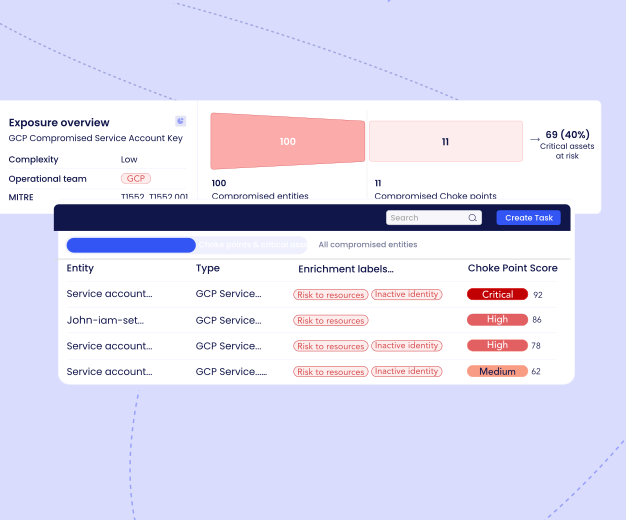
The hidden costs come in the form of modular fragmentation and “licensing creep.” To get comprehensive exposure visibility from an infrastructure provider, organizations are often forced to buy premium add-on modules for identity, data posture, cloud workloads, and endpoints. This creates a complex modular tax. XM Cyber offers a streamlined, continuous approach that provides comprehensive hybrid visibility, prioritizing your security backlog around validated choke points to save your engineering teams thousands of hours of wasted remediation effort.
Attackers don’t work in silos.
Neither should you