It’s time to move from Theory to Reality
XM Cyber vs Wiz
XM Cyber provides continuous exposure management across hybrid environments, using a digital twin approach to uncover and validate how assets, identities, exposures interconnect to form complex attack paths leading to critical assets and data. The platform breaks down traditional silos between traditional on-prem and cloud-native security tooling and processes, taking an adversary-aware approach to understand how real-world attack scenarios could put your business at risk.
Why XM Cyber?

The XM Difference:
Unified Exposure Management, Without Coverage Or Operational Silos
Features
-
Complete Hybrid Attack Surface Visibility
Wiz is designed primarily for securing cloud environments, but it lacks native depth of support for on-premises networks, endpoints, workstations, or complex Active Directory structures, relying heavily on third-party integrations and their Dazz acquisition to bridge the gap. Conversely, XM Cyber provides holistic, native support for hybrid enterprise environments, using purpose-built assessment approaches to map exposures continuously across a diverse set of asset and environment types.
-
Outside-In and Inside-Out Attack Surface Visibility
While Wiz offers EASM capabilities within their cloud exposure management suite, it falls short of connecting the dots between external exposures and internal lateral movement outside of cloud-native infrastructure. Conversely, XM Cyber seamlessly maps complex attack paths originating from internet-exposed assets, providing a complete, end-to-end view of risk from the initial external breach point straight through your on-premises network to your critical assets.
-
Continuous Exposure Validation
Wiz detects a wide range of static risk findings and configurations across cloud environments, but it lacks the active simulation capabilities needed to help teams move beyond theoretical risk to proven exploitability. XM Cyber continuously validates discovered exposures against hundreds of real-world attack scenarios, providing deep insight into the presence and configuration of existing compensating controls to prove absolute reachability, exploitability, and business impact.
-
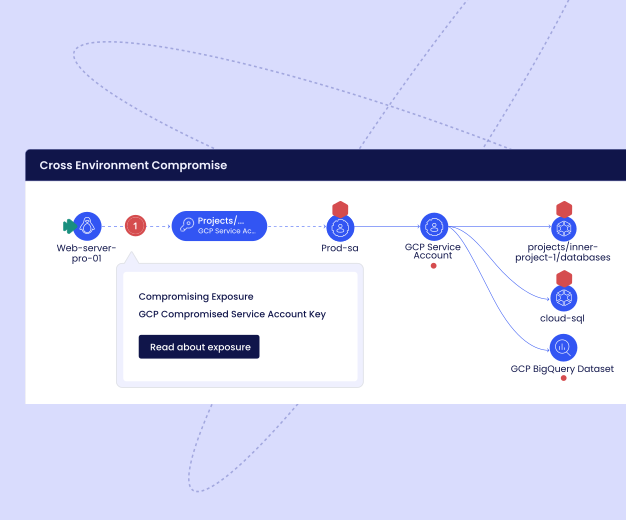
Hybrid and Cross-Environment Attack Path Mapping
Wiz provides attack path mapping restricted to cloud infrastructure through its "Security Graph," but it cannot extend this visibility natively into traditional on-premises networks or legacy enterprise directories. XM Cyber every possible path within and across hybrid environments, uncovering otherwise hidden paths attackers could take to move between on-prem and cloud environments.


-
Complete Hybrid Attack Surface Visibility
Wiz is designed primarily for securing cloud environments, but it lacks native depth of support for on-premises networks, endpoints, workstations, or complex Active Directory structures, relying heavily on third-party integrations and their Dazz acquisition to bridge the gap. Conversely, XM Cyber provides holistic, native support for hybrid enterprise environments, using purpose-built assessment approaches to map exposures continuously across a diverse set of asset and environment types.
-
Outside-In and Inside-Out Attack Surface Visibility
While Wiz offers EASM capabilities within their cloud exposure management suite, it falls short of connecting the dots between external exposures and internal lateral movement outside of cloud-native infrastructure. Conversely, XM Cyber seamlessly maps complex attack paths originating from internet-exposed assets, providing a complete, end-to-end view of risk from the initial external breach point straight through your on-premises network to your critical assets.
-
Continuous Exposure Validation
Wiz detects a wide range of static risk findings and configurations across cloud environments, but it lacks the active simulation capabilities needed to help teams move beyond theoretical risk to proven exploitability. XM Cyber continuously validates discovered exposures against hundreds of real-world attack scenarios, providing deep insight into the presence and configuration of existing compensating controls to prove absolute reachability, exploitability, and business impact.
-
Hybrid and Cross-Environment Attack Path Mapping
Wiz provides attack path mapping restricted to cloud infrastructure through its "Security Graph," but it cannot extend this visibility natively into traditional on-premises networks or legacy enterprise directories. XM Cyber every possible path within and across hybrid environments, uncovering otherwise hidden paths attackers could take to move between on-prem and cloud environments.
Connect to hundreds of distribution channels


What Our Customers Say

“We found XM Cyber’s platform to be a very mature product with holistic view, something that shows the entire network and shows us how to get from A to B to Z”


“The assistance that XM Cyber can give to the dialogue between the CISO and the executive level and the board level is tremendous”

“Monitoring, dynamically, continuously, how the posture is changing and the capability to correct possible configuration mistake”

״XM Cyber helped us to go from thousands of critical vulnerabilities that we have to just 10, 15 that we could fix. And with this, we prevented the breach of our crown jewels.”


“One of the things that I liked the most was that it presented resolutions for the exposures you have, and not just one, it presents us with several resolutions, several possibilities to remediate the exposures, and I liked that”


“XM Cyber is an important layer of security… Normally, you have to prove to IT to patch and change configurations. Not with XM Cyber.”


“Understanding different attack types and how they move around in an environment, that’s really where XM Cyber plays a big part for us.“


“To date we improved our score from 69 to 87. This was highly appreciated by my directors on the last board meeting.”

Total Economic Impact Study™ of XM Cyber
394%
Return on investment, with payback in under 6 months
$12.4M
Reduction in remediation, fines, lost revenue, and brand reputation costs
$1.4M
Reduction in costs associated with penetration testing
90%
Reduction in the likelihood of experiencing severe breach
FAQs
Can CNAPP solutions effectively replace exposure management platforms?
No, while CNAPP solutions offer broad and deep coverage for cloud environments and workloads, they lack the specialized architectural depth needed to comprehensively map on-premises infrastructure, corporate endpoints, or complex Active Directory ecosystems. Comprehensive exposure assessment platforms unify bring together attack surface visibility and exposure assessment into one place, with purpose-built discovery and assessment approaches that don’t rely on cursory API-based integrations to aggregate asset and exposure findings from third-party scanners.
Is the Security Graph the same as Attack Graph AnalysisTM, do they use a digital twin?
No. The Wiz security graph is not built using a digital twin approach, and they are not conducting continuous Attack Graph AnalysisTM. The Wiz security graph, like many other attack path analysis solutions, uses a graph database to visualize toxic combinations discovered across cloud environments. These configuration-based paths are constructed to show relationships between cloud resources and exposures, but do not dynamically replicate the environment, validate exploit conditions or run scenario-based simulations to prove exploitability and potential business impact.
Does cloud security posture management (CSPM) provide the same security value as dynamic exposure validation?
No. Cloud posture management relies on identifying resource configurations across production cloud environments using agentless, API-based scanning to identify misconfigurations or misalignment with compliance policies. Dynamic exposure validation goes a step further by evaluating those discovered risks against hundreds of simulated, real-world attack scenarios, analyzing a host of exploit conditions that must be true for an attacker to weaponize a given misconfiguration. By continuously calculating the real-time presence and live behavior of existing compensating security controls, dynamic validation proves whether an asset is actually reachable and exploitable, preventing security teams from wasting time on non-attackable flaws.
How does an Exposure Assessment Platform (EAP) handle external (outside-in) vs. internal (inside-out) threats compared to EASM tools?
Standalone External Attack Surface Management (EASM) tools scan the internet-facing attack surface to identify public-facing exposures, and many CSPM solutions will determine public accessibility using resource configurations derived from agentless cloud scans. However, these tools fall short of connecting those external entry points to internal lateral movement routes across the entire hybrid environment. A modern Exposure Assessment Platform (EAP) incorporates exposure validation across the entire attack path, mapping every step an attack could realistically take from external breach point to internal critical assets and data, whether they’re in the cloud, on-prem, or both.
Why is holistic context critical when validating attack paths across a hybrid estate?
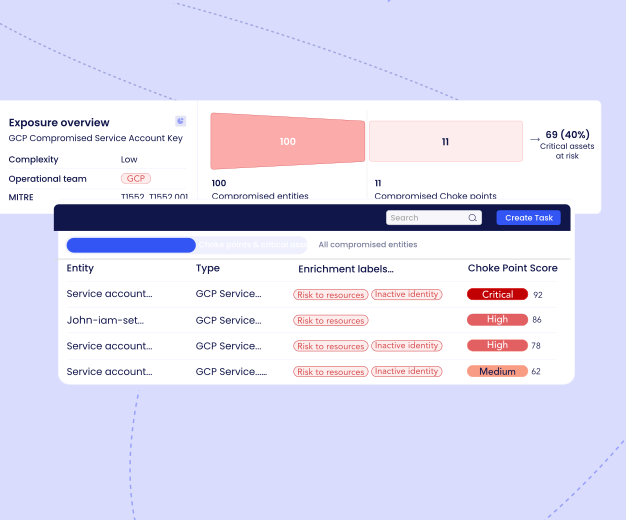
Relying entirely on separate tools for cloud security and on-premises posture creates an operational blind spot that attackers exploit, particularly with how common it is for attackers to breach cloud environments with credentials stolen or leaked from on-prem assets. Whichever tooling approach is utilized, it is absolutely critical that security teams validate exposures and hybrid attack paths dynamically and holistically, while fully taking into account the real-world presence and live configurations of existing security controls. Incorporating this comprehensive context at every single stage of the validation lifecycle ensures that engineering teams can clearly prioritize and remediate the vital intersection points, or choke points, that eliminate the maximum amount of systemic risk across the entire organization.
Attackers don’t work in silos.
Neither should you