
|
Getting your Trinity Audio player ready...
|
What are Exposure Assessment Platforms (EAP)?
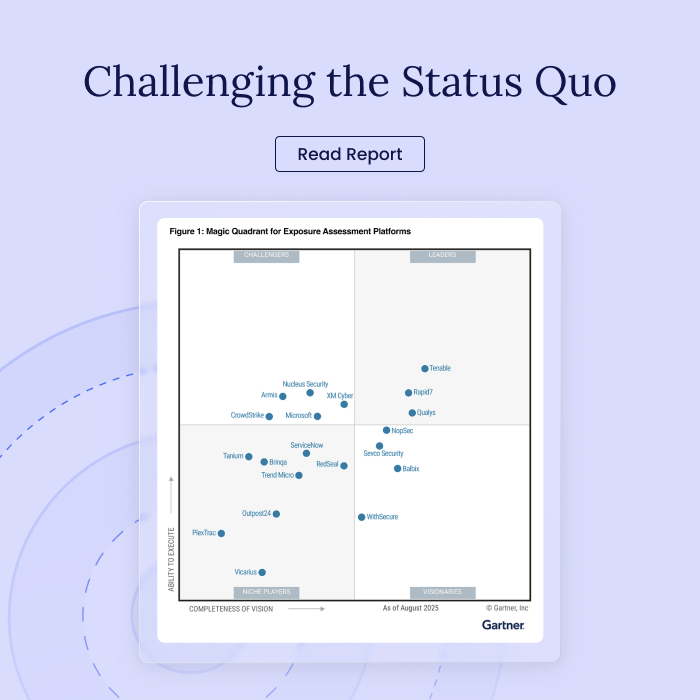
Exposure Assessment Platforms (EAPs) are a new, consolidated category of security solutions coined by Gartner that serve as a key technology enabler of the CTEM framework. These platforms provide security teams a single platform to continuously discover, assess and facilitate remediation of exposures across their attack surface.
Importance of EAP in Cybersecurity
The core value of EAPs is the role they play in enabling security teams to transition from reactive vulnerability and risk management processes to a more proactive and threat-aware approach.
Today, security teams often use dozens of disparate security solutions to address discrete use cases like network vulnerability management, cloud security, application security and identity and access management. These tools often create operational silos and deliver lists of uncorrelated findings that lead to blind spots, excess noise, and inefficient remediation processes that ultimately fail in protecting organizations from modern threats.
EAPs help organizations address these challenges and adopt a CTEM approach by unifying attack surface visibility and risk findings, allowing teams to uncover how exposures can be chained together to move laterally across your environment compounding risk and gaining access to your critical assets.
EAPs also enable teams to enrich asset and exposure data with real-world threat intelligence to help prioritize remediation efforts and validate exploitability. Crucially, this ensures that limited cyber resources are directed toward addressing the most critical issues first, and security leadership has an effective way to communicate risk posture and remediation progress to executive leadership.
How Do EAPs Work? A Step-by-Step Breakdown
EAPs provide a single platform that unifies attack surface visibility and risk findings into one place, transforming raw data from first and third-party sources into actionable insights, enabling organizations to manage risk with confidence. Here’s how these solutions work:
- Data Collection: EAPs typically offer a variety of ways to collect asset data and telemetry from complex environments, including endpoint agents, network scanners, recursive internet scans, APIs and integrations with 3rd party ITOps and security tools.
- Asset and User Discovery and Classification: EAPs ingest asset and user data including everything from workstations, servers and IoT devices to code repositories, correlating and deduplicating entities to provide a true picture of the organization’s attack surface. Assets and users are categorized and enriched with metadata to identify business critical assets and prioritize remediation efforts.
- Exposure Assessment and Prioritization: Whether using first or third party scanners or sensors, EAPs continuously assess the entities across the attack surface for exposures including vulnerabilities, misconfigurations, identity-related risk and more. Exposures are typically scored based on exposure severity, exploitability and potential impact.
- Threat Mapping: Advanced EAPs will enrich exposure findings with available threat intelligence, linking risk findings to active and real-world threats to help provide situational awareness and enable informed prioritization decisions. This information can also be shared with SOC teams for threat hunting, detection engineering, alert triage, and incident investigation.
- Remediation Guidance: EAPs play a critical role in exposure remediation, often providing step-by-step remediation guidance and integrating with notification and ticketing systems to automate case management and streamline cross-team collaboration. Advanced EAPs will also offer automated remediation capabilities including automated and virtual patching, rightsizing permissions or adjusting resource configurations.
- Reporting and Metrics: EAPs deliver clear and actionable insights through a combination of dashboards and executive level reporting capabilities that allow security teams to communicate risk posture across the organization and track progress over time. Platforms often offer their own native reporting capabilities alongside the ability to export findings into common reporting and analytics tools to ensure interoperability with existing workflows.
Key Features of EAPs
Exposure Assessment Platform (EAP) platforms differ in their approach and some have unique advantages over others, but the majority offer the following key features:
- Comprehensive Asset Management: Maintains a deduplicated, up-to-date inventory of all IT assets, preventing overlooked devices and applications.
- Continuous Exposure Assessment: Detects network and software vulnerabilities, misconfigurations, identity-related risks, and more in real time, enabling fast response before exploitation.
- Automated Risk Prioritization: Scores and ranks exposures by exploitability and impact to focus attention on critical threats.
- Threat Intelligence Enrichment: Contextualizes exposure data with external feeds to flag known exploits, attack techniques, and associated threat actors.
- Advanced Reporting and Analytics: Generates actionable insights through detailed reports to monitor exposure levels and guide risk mitigation decisions.
Benefits of Using Exposure Assessment Platforms
EAPs offer a number of significant benefits to security teams, including:
- Improved Visibility and Situational Awareness: By integrating with and enriching existing CMDB and security tools, EAPs uncover blind spots and bring clarity to often disjointed and conflicting asset inventories generated from siloed point solutions.
- Better-informed Risk Prioritization: Because EAPs continuously assess vulnerabilities and evaluate them based on severity and exploitability, they help ensure that resources are focused on the most critical threats. This ultimately reduces the likelihood of breaches.
- Accelerated Risk Reduction: By enabling teams to operate more efficiently and focus on the most impactful risk findings, EAPs allow security teams to proactively and quickly remove risk from their environments. These platforms often enable bulk risk removal by highlighting fixes that can eliminate exposures across a range of entities in the environment.
- Streamlined Operations and Team Efficiency: EAPs play a critical role in streamlining and expediting security operations by automating typically manual and time-consuming processes. This enhanced efficiency frees up security teams to focus on higher-priority tasks and spend less time on tactical, repetitive workflows.
- Assist in Maintaining and Proving Regulatory Compliance: EAPs help teams align with regulatory requirements and prepare for audits, while fostering a shared definition of risk with internal GRC teams.