

|
Getting your Trinity Audio player ready...
|
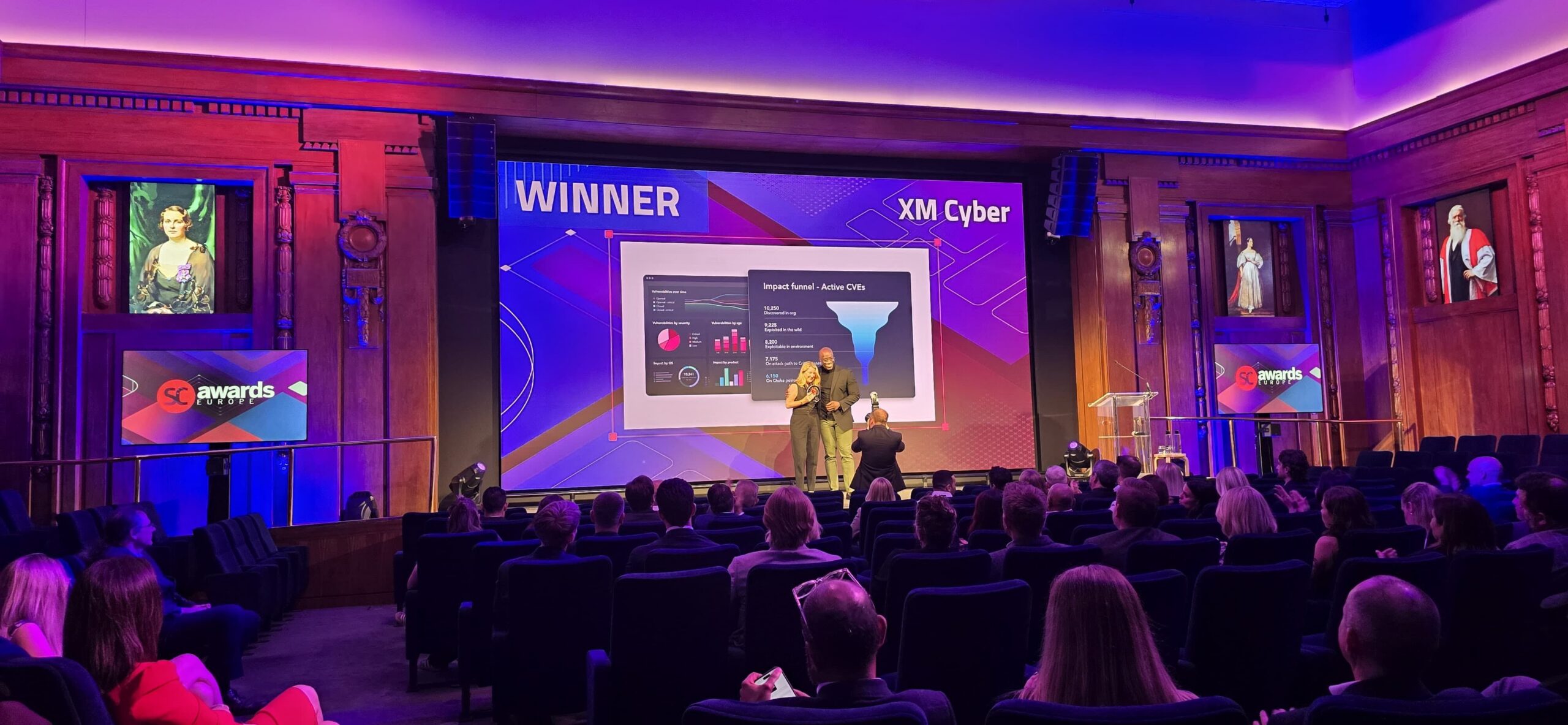
The vulnerability management category has shifted. For three consecutive years, Qualys won SC Awards Europe Best Vulnerability Management Solution. This year, the judges acknowledged XM Cyber – an integrated platform built around attack graph analysis for achieving continuous exposure discovery, validation, prioritization, and remediation across the hybrid digital environment.
The judges called XM Cyber “one of the standout submissions across the entire awards programme.” The reasons they said this are a reflection of where the category is heading. In this blog, we’ll look at what the judges recognized, why the VM category is moving in this direction, and what it means for teams still running scan-and-patch.

What the Judges Saw
The SC Awards write-up praised XM Cyber for “clear differentiation from conventional vulnerability management tools.” The judges highlighted attack simulation, attack graph analysis, and CTEM-aligned methodologies as the reasons XM Cyber stood apart. They also pointed to ROI figures, demonstrated budget savings, and customer validation from IQUW, a London-based specialty reinsurer.
The judges recognized that the legacy scan-score-patch cycle buries teams in work that frequently doesn’t map to actual risk. The 2026 Verizon DBIR backs this up, finding that only 26% of KEV vulnerabilities were ever fully remediated – not because defenders couldn’t get to the rest, but because most of them weren’t relevant to the paths attackers actually take. What’s more, exploitation timelines have compressed to near zero, and remediation timelines have grown to 43 days. These numbers are the writing on the wall. When the dominant model can’t separate out the vulnerabilities that matter, the category has to move.
What Attack-Path-Led VM Looks Like
The SC judges used a specific phrase in their write-up: “attack-path-led innovation.” What does that look like in practice? Traditional VM tools produce a list of vulnerabilities ranked by severity. Attack-path-led VM starts from a more practical perspective: using a given vulnerability or sequence of vulnerabilities (and not just CVEs), what can an attacker actually reach, and how do they get there? The XM Cyber platform models the full environment – on-prem, cloud, hybrid – and traces every viable route from initial access to critical assets. Vulnerabilities that sit on those routes get prioritized. Vulnerabilities that don’t are set aside as dead ends.
The judges also praised the platform’s ability to identify what XM Cyber calls choke points – single fixes capable of disrupting multiple attack paths at once. XM Cyber’s own research found that 74% of exposures are on dead ends that can’t reach critical assets. The remaining 26% carry the actual risk. And where multiple attack paths run through the same vulnerability, one fix closes dozens of paths. Those convergence points are what XM Cyber calls choke points.
Continuous validation is the last XM Cyber value proposition that the judges highlighted. The platform retests after every remediation action to confirm the path is actually closed, not just marked as ‘resolved’ in a ticket. The SC write-up specifically called out “closed-loop validation” as a differentiator – the ability to prove that a fix worked, not just assume it did.
What’s Next?
XM Cyber continues to expand the platform’s coverage and capabilities for discovering, prioritizing, and mitigating vulnerabilities as part of the overall threat landscape. Over the coming months we will add four new pillars of visibility to feed into our PostureDNA™: Discovery Scanning, Network Vulnerability Scanning, Cryptography Scanning, Container and Cloud Workloads Vulnerability Scanning. We will also empower teams to take action faster and more effectively by expanding our remediation integrations with leading ticketing systems and SIEM/SOAR solutions. With pre-built playbooks based on complete remediation guidance and with remediation confirmation, security and IT teams can close the exposure window and get ahead of attackers.
The Bottom Line
The SC Awards have tracked the VM category for years. The shift from legacy vulnerability management vendors to XM Cyber in 2026 validates the broader change in how the industry defines the problem. Vulnerability management is no longer just about finding vulnerabilities – it’s about understanding which ones an attacker can actually use to reach critical assets. The category needed a new benchmark. The SC judges just set one.
Want to see how attack-path-led VM works in your environment? Let’s talk.